Mouse in the House background

Wednesday, July 20, 2011

Where bloggers create -- a studio tour

Vintage picnic tins and antique drawers in my studio

If you've been following my blog, which shares vintage images, you would guess that I like all kinds of vintage things, and you would be right!  Today I thought I would share with you photos of some of the vintage items in my studio by participating in "Where Bloggers Create," a virtual studio tour sponsored by My Desert Cottage blog.   I just heard about this project today, and it turns out the deadline was July 15 -- so my studio is not on the tour list after all... next year! I hope you will come in and look around anyway.

Above you see part of my collection of vintage picnic tins. These are just to the left of the stairs at the entrance to my studio, which is off our dining room. I just love these colorful tins for display and storage.  I use a shipping tag tied with string to identify the contents of each tin.


The dark oak drawers were originally office filing cabinets, but I was thrilled to discover that the shallow drawers were perfect for holding rubber stamps.  Old drawers are usually quite dirty and hard to clean, so I have lined these drawers first with paper, and then with plastic thrift store picture frames.  The frames are handy because when I am doing a stamping project, I can pull the frame "tray" out and use it at my counter, which keeps like stamps together and makes them easy to put away.


Above the first stacks of picnic tins is a clown game poster from a vintage toys exhibit my husband and I saw in Paris in 1984.  It adds more bright color to my studio and reminds me of a wonderful trip.


The only non-vintage furniture in the studio is kitchen cabinetry pieces purchased from a dismantled showroom. This counter, on the wall nearest the entrance, is where I do all my cutting with my lighted Genesis Paper Trimmer. The exposed brick was once the outside wall of our house before we added my studio. 


To the right of the drawers and stacks of tins are two library card catalog cabinets which store embellishments and office supplies.  I paid $2 for the shabby yellow chair at a thrift store.  It's so sturdy, I can use it to reach high shelves. (I'm only 5'2" so it comes in quite handy!)


On top of the card catalog drawers are my red Smith Corona typewriter and vintage office supplies, which I love to collect. 


Above the card catalog cabinets is a wall cabinet filled with vintage packaging. I love the colors, the images and the promises on vintage product packaging; all of these packages are inspiring to me and sooo much fun to collect.


To the right of the card catalogs, more shallow drawers hold specialty papers. On top of the drawers is my red toolbox and a display of vintage games.

A vintage armoire holds envelopes, more paper and other items that aren't as much fun to look at; then I have utilitarian white shelving that holds wood-mounted rubber stamps and punches. The tall oak office piece, once a postal cabinet according to postalhistory.com, has shallow storage space for more rubber stamps on trays.  The postal cabinet has what looks like drawers, but are  actually covers that slide upward and inward to reveal shelves. 


This 42-drawer apothecary cabinet is hard to photograph because there is an island counter in the center of the room in front of it. An old store display case with sliding glass doors holds more rubber stamps, and the vintage jars on top hold game pieces for assemblage projects, plus balls of fibers.


This old gas station maps case was found in the trash -- one of my favorite freebies.

That's about half of my studio -- storage, inspiration and cutting station.   I'll post photos of the remainder another day. Hope you enjoyed the tour!

Friday, July 15, 2011

More lovely ladies on bridge tallies

These lovely ladies are from an undated bridge set published by Charles S. Clark Co.  The larger images are from the diecut covers of bridge score pads, and the small round images are individual bridge tallies. The tallies had decorative fringed ties through the holes -- very fancy!


Text inside the scorepads refers to progressive auction bridge (which was originated in 1904), and mentions that "Some prefer to play by the new laws of progressive auction bridge," which may have changed in 1927 after the creation of the American Contract Bridge League.  (If there are any bridge history experts out there, please correct me if this is not the case!)


I'm just enthralled with the artwork!  I hope you like it, too.


As always, click on any image to enlarge it, then right click on the enlarged image to save it to your computer. 


I'd love to see any projects that use the vintage images shared here. Please send pictures of your work if you've created something with these.


Working on art projects indoors is a good way to keep cool in this heat wave.
Happy creating!

Monday, June 20, 2011

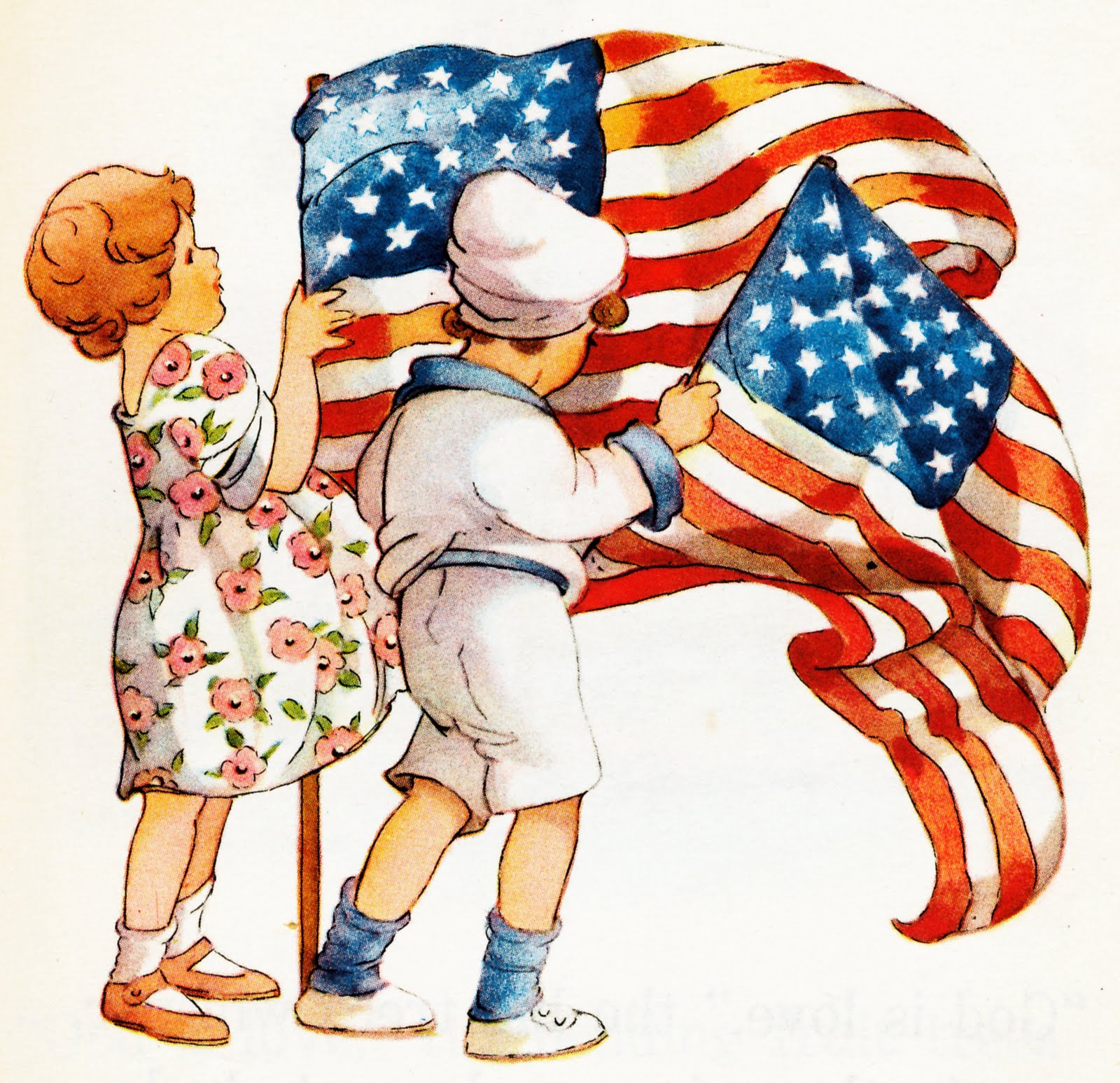
Vintage patriotic image for July 4th


I decided to post this patriotic illustration now instead of waiting until July 4th, in case any of you like to make Independence Day cards. This lovely image is from the Standard Bible Story Reader, Book One, published in 1925. This sweet little book credits two illustrators: O.A. Stemler and Bess Bruce Cleaveland. I'm guessing this unsigned illustration is from Cleaveland, based on others that were signed by her, but I'm not positive.

Enjoy the holiday!

Tuesday, June 14, 2011

Vintage images for Father's Day

Searching for masculine vintage images to use on Father's Day cards or projects, I was surprised to discover that most ads in my vintage magazines were directed at women.  The bicycle, boat and electric train ads below were exceptions.  My favorite "Father" images are these, from a 1937 reader called "At Work and Play."


Ads below are from an 1897 edition of The Cosmopolitan magazine.


If you make a Father's Day card using any of these images, please send us a link or a photo!  Happy Father's Day.


Thursday, June 9, 2011

Beauty advice booklets from the 1960s

Women who wanted beauty advice in 1963 could choose from a huge catalog of 25-cent booklets published by the Bonomo Culture Institute.  The creator of these handy pocket manuals was Joe Bonomo, a body-builder (Mr. Modern Apollo of 1921) and self-proclaimed "International Authority on Beauty, Health, Diet and the Self-Improvement of Face and Figure."

No. 13 in the Bonomo Pocket Manual series was a NEW! Bonomo Beauty Ritual: How to Beautify Your Bust Contour, featuring the home course techniques.  This little 3"x5" book boasts 64 easy-to-follow pages completely illustrated with photographs, diagrams and charts.  It includes 41 separate exercises for building your bust.


Bonomo Handy Pocket Manual #1 was "Make-up -- and LIVE!" which promised Beauty in 10 Easy Steps, including some very interesting facial exercises (scroll down).


The lovely woman who modeled these facial exercises may have developed some new wrinkles after this photo shoot.

An outfit called Happiness Books of Stanford, Connecticut, also published pocket-sized books with beauty hints.  "Hairdo Secrets" cost 25 cents and had 64 pages, just like the Bonomo books.  It's not clear who copied whom.


Some classic tips and llustrations from the Hairdos booklet:


The 1960s woman holding a sign might be fun to use on a greeting card or scrapbook layout. If you want edited versions of any of the other images, just let me know in the Comments.


Don't forget to splurge, ladies!


Wednesday, June 1, 2011

Advertising calendar from 1900

Today's images from an amazing flea market find:  a diecut triptych calendar from 1900. It's hard to believe something printed in 1899 could look so crisp and beautiful today. Only the creases are worn. 


The lovely gold-embossed illustrations were from an unlikely source:  a company that manufactured rubber boots! This calendar was compliments of Enterprise Rubber Company, 207 Congress Street, Boston. On the back of these lovely pictures are discussions of mortality statistics -- with emphasis on consumption and pneumonia -- and the importance of dry feet.  And speaking of unlikely, one of the models in the triptych is a gold miner... a 111-year-old precursor to modern-day calendars featuring photos of hunky firemen?


My favorite quotes from this amazing calendar: 

"The rubber shoe is almost the humblest article in the human wardrobe; and at the same time, it is one of the greatest life preservers of our modern civilization."  Zion's Herald

"When Goodyear discovered how to make rubbers, human longevity took a great bound forward."  Popular Science

Here are the images without the borders and dates.


Wishing you dry feet and a long, healthy life!